
Skip to content
ATS Mako
Candidate Engagement

Measure the metric that predicts every hire

The exact formula for candidate response rate, the mistakes that fake it, and the levers - channel, speed, and automation - that actually move it up.

30-day free trial. No setup fees, no long-term contracts.

The definition

What candidate response rate actually measures

Every great hire starts with a conversation. Candidate response rate is the cleanest way to see whether those conversations are happening, and it moves before any other hiring metric does.

It measures conversations, not sends

Candidate response rate is the share of the candidates you reached who actually replied. It is a two-way signal. Delivery, opens, and clicks tell you a message landed. Response rate tells you a candidate leaned in and answered you back.
It is a leading indicator of speed to hire

Every hire starts with a conversation. When more candidates answer, more move forward, and time-to-fill drops. A rising response rate is the earliest sign your pipeline is getting faster, long before it shows up in placements.

It is channel-specific for a reason

A single blended number hides the truth. Text and email get answered at very different rates, so measure each channel on its own before you compare them or set targets.

The formula

One equation, calculated the same way every week

Response rate is only useful when it is consistent. Fix the numerator, the denominator, and the window, and the trend line tells the truth.

Candidate response rate =

(Unique candidates who replied ÷ Candidates actually reached) × 100

Calculated per channel, inside a fixed reply window. Report SMS and email separately.

Denominator

Candidates reached

Count real recipients only. Strip bounces, undeliverable numbers, and duplicates before you divide, or the rate reads high for the wrong reason.

Numerator

Candidates who replied

Count unique candidates who sent any inbound reply. Count a person once, not once per message, so a chatty candidate does not inflate the number.

Window

The time frame you allow

Fix a reply window, for example 72 hours from first touch, so late replies to old outreach do not distort this week's number.

Result

Response rate

Replies divided by reached, per channel, inside the window. Report it the same way every week or the trend line lies to you.

Measure it honestly

Five mistakes that fake a good response rate

A number that looks great can hide a pipeline that is going quiet. Avoid these and your metric will finally match reality.

01

Dividing by sends instead of by real recipients

If your denominator includes dead numbers, hard bounces, and duplicate records, your response rate looks better than reality. Clean the list to actual deliveries first. Real-time SMS delivery receipts and email bounce handling let you count only the candidates a message truly reached.

02

Counting messages, not people

A candidate who fires off three texts is one response, not three. Deduplicate to unique candidates so a handful of engaged people do not paper over a silent majority.

03

Blending SMS and email into one number

Text and email behave nothing alike. Averaging them buries the channel that is failing. Track each channel separately, then decide where to lead.

04

Ignoring the reply window

A reply four days later did not help you fill the shift on Friday. Without a fixed window, stale replies inflate the metric and hide how slow the conversation really was.

05

Skipping time-to-first-reply

Response rate without response speed is half the picture. A 60 percent rate where replies land in seconds beats a 60 percent rate where they trickle in overnight. Track both together.

What drives it up

Six levers that move response rate up

Once you can measure it cleanly, these are the levers that actually move the number. Communication is the core, not an add-on.

1

Lead with the channel candidates answer

Frontline and high-volume candidates read texts they never open in email. Two-way SMS with a centralized conversational inbox puts the first touch on the channel that gets a reply, with email as the backup. Most ATS platforms treat communication as an add-on. ATS Mako makes it the core.

2

Answer in seconds, not hours

Speed is the single biggest lever on response rate. Status-triggered SMS and email fire the moment a candidate lands in the pipeline, so the first message reaches them while their interest is at its peak instead of a day later next to faster competitors. Set the trigger. We handle the rest.

3

Make every message personal at scale

Generic blasts get ignored. Dynamic merge fields like first name, position, and interview time personalize outreach for thousands of candidates without a recruiter typing each one. Update once, deploy everywhere, from a preloaded and custom template library.

4

Follow up only when there is no reply

Multi-step email sequences with conditional logic follow up automatically when a candidate goes quiet, space themselves across days, and stop the instant a candidate answers. Persistent without pestering, so no warm candidate slips through the cracks.

5

Watch replies land in real time

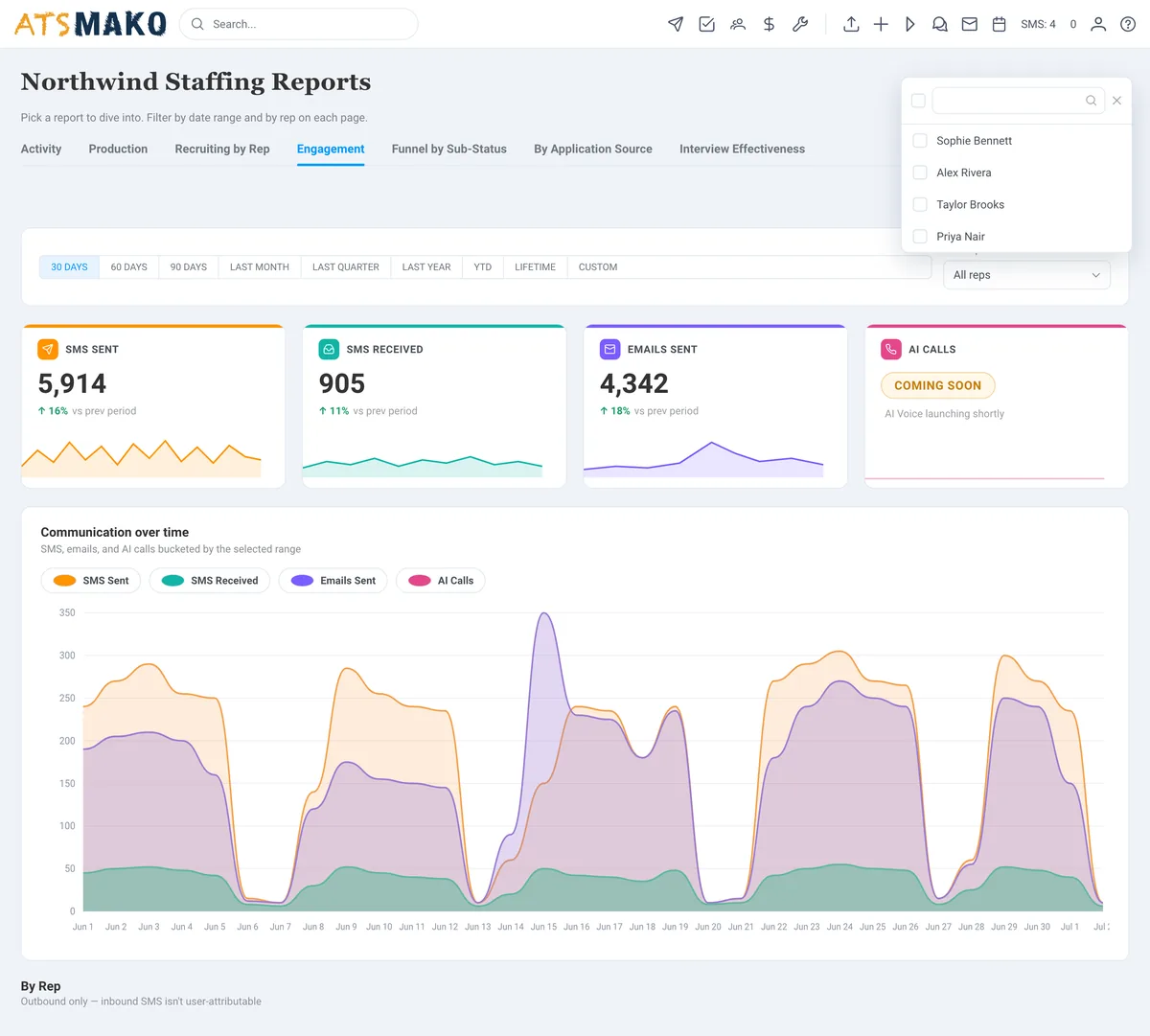
Real-time engagement tracking surfaces opens, link clicks, reply detection, and SMS delivery receipts in one timestamped activity feed. You see who answered and who went silent the moment it happens, so recruiters chase the right people. Stop guessing. Start knowing.

6

Keep it compliant so it keeps working

High response rates only hold when candidates trust you. Send with lawful prior consent, a clear opt-out such as Reply STOP, business-hours-only timing, and automatic unsubscribe handling. Compliance is not a tax on response rate. It protects it.

Report it well

Turn the number into a habit, not a headline

A response rate you check once a quarter tells you nothing you can act on. Report it live, segment it, and pair it with speed.

Dimension

Reporting frequency

Customized reporting keeps response rate current, so you fix a dip before it becomes a hiring gap.

Slow: Quarterly recap
Good: Weekly review
Fast: Live dashboard

Segmentation

Dynamic audience segmentation shows exactly which requisitions and properties are getting answered.

Slow: One blended number
Good: By channel
Fast: By channel, role, and location

Paired with

Response rate alongside speed and fill metrics tells you whether faster conversations are actually closing hires.

Slow: Nothing
Good: Time-to-first-reply
Fast: Time-to-reply and time-to-fill

A note on benchmarks: ATS Mako's homepage cites an illustrative 87 percent candidate response rate. Treat any published figure, including that one, as directional rather than a guaranteed outcome. The number that matters is your own, measured the same way every week and trending up.

From first touch to offer letter

A higher response rate should end in a signature

Response rate is a means, not the goal. When more candidates answer faster, more reach the offer stage - so close the loop there too. ATS Mako lets you generate branded offer letters and have candidates accept and e-sign online as a native step in the recruiting lifecycle, keeping your logo, your colors, and your domain on the document from first touch to signature.

It is one platform instead of nine disconnected tools that never talk to each other - so the same system that lifts your response rate is the one that measures it and closes the hire.

ATS Mako real-time engagement analytics showing candidate reply and open tracking
Questions, answered

Candidate response rate FAQ

What is a candidate response rate?

Candidate response rate is the percentage of candidates you reached who replied to your outreach within a set time window. It is calculated per channel as unique candidates who replied divided by candidates actually reached, then multiplied by 100.

How do you calculate candidate response rate?

Divide the number of unique candidates who replied by the number of candidates a message actually reached, inside a fixed window such as 72 hours, then multiply by 100. Strip bounces and duplicates from the denominator, count each candidate once in the numerator, and calculate it separately for SMS and email.

What is a good candidate response rate?

It varies by channel, role, and candidate audience, so treat any published figure as directional rather than a guarantee. SMS is typically answered far more than email. The most useful benchmark is your own trend line: measure it the same way every week and work to move it up.

Why is my candidate response rate low?

The most common causes are slow first replies, leading with email instead of text, generic non-personalized messages, and no automated follow-up when a candidate goes quiet. Answering in seconds, personalizing with merge fields, and following up conditionally are the fastest ways to move the number.

Does SMS get a higher response rate than email?

Generally yes. High-volume and frontline candidates read and answer texts they never open in email, which is why leading with two-way SMS and using email as backup tends to lift overall response. Always send with lawful prior consent and a clear opt-out.

How does ATS Mako help improve candidate response rate?

ATS Mako makes communication the core of the platform: two-way SMS and email, status-triggered automations that reply in seconds, personalized templates with merge fields, conditional follow-up, and real-time engagement tracking - all in one white-label system so every touch is fast, on-brand, and measurable.

Related reading: high-volume hiring, the communication engine, and real-time engagement tracking.

Designed for speed. Built for scale.

Turn more replies into more hires

Put communication at the core of your ATS and watch response rate, and time-to-fill, move in the right direction.

Free support and guided onboarding included. No hidden fees.