
Recruiting automation playbook
One cadence. Every channel.
Sequence SMS, email, and AI calls into one orchestrated multi-touch cadence that moves high-volume candidates from first apply to signed offer - without a recruiter chasing replies.
30-day free trial. No setup fees, no long-term contracts.
The problem with a single channel
A message is not a cadence
Most recruiting teams have a text template, an email template, and a phone to dial - and they fire them off in no particular order, whenever someone has a spare minute. That is not a cadence. It is three disconnected tools taking three separate shots and hoping one lands.
A cadence is an ordered, timed sequence: the right channel, at the right moment, with an exit the instant a candidate replies. Build it once and it runs on every applicant, on every shift, at thousand-candidate scale. Here is how to sequence SMS, email, and AI calls into a single engine that keeps every interaction fast, automated, and on your brand.
Why sequence at all
Every candidate answers on a different channel
You cannot predict which touch converts, so a cadence runs all three and lets the winner reveal itself. Here is what a single channel misses.
One channel means one chance to be ignored
Send only email and the fast, frontline candidates who live in their texts never see you. Send only SMS and the passive, senior applicant who checks messages once a day slips through. A single channel bets your whole pipeline on one habit. A cadence covers every habit.
Random one-off blasts are not a sequence
A text on Monday, an email on Thursday, and a call whenever a recruiter remembers is not a cadence - it is noise. Without order, timing, and exit rules, candidates get double-messaged, pestered after they already replied, or dropped after touch two. Orchestration is the whole point.
Speed to first touch decides the funnel
The moment an application lands is the moment interest peaks. If the first channel does not fire in seconds, the candidate is already talking to a faster employer. A cadence front-loads the fastest channel and lets the slower ones carry the follow-up.
The touchpoint that converts is different every time
Some candidates book off the confirmation text. Some open the email three days later. Some only pick up when an AI voice screen calls them. You cannot predict the one that lands, so a cadence runs all three in sequence and lets the winner reveal itself.
The three channels
What each channel is actually for
A cadence works because each channel does a different job. Assign the roles, then let the sequence orchestrate them.
The fast opener and the closer
Two-way SMS from a centralized conversational inbox gets the instant reply that email cannot. Lead with it on the first touch, and lean on it again to confirm interviews and nudge stalled candidates. Every automated text carries a clear opt-out and sends only during business hours.
The carrier of detail and proof
Multi-step email sequences with conditional logic carry the role details, the branded page link, and the follow-up that only fires when there is no reply. Open, click, and reply tracking tells the cadence what to do next, and automatic unsubscribe handling keeps it compliant.
The screen that scales the human touch
AI voice screening calls candidates, asks your qualifying questions, and feeds the results straight into the pipeline. It reaches the applicant who never texts back and screens an entire segment at once with a mass AI call campaign - no recruiter dialing one number at a time.
The end-to-end cadence
A seven-touch sequence, mapped
An illustrative multi-channel cadence for high-volume hiring - timing is directional, not a guaranteed outcome. Every follow-up is conditional and exits the moment a candidate replies.
- 1Minute 0 SMS
Instant confirmation
A status-triggered text fires the second the application lands - names the candidate, confirms the role, and offers one easy next step. Set the trigger, and it sends day or night, queued to business hours.
- 2Minute 0 Email
Branded detail follow-up
A parallel email carries the full role details and the link to your branded Apply Here page, so the candidate has everything in the channel they check on their own time.
- 3Hour 4 AI call
AI voice screen
If the candidate engaged, an AI voice call runs the qualifying questions and scores the fit. If they went quiet, the call becomes the second attempt to reach them on a channel SMS and email missed.
- 4Day 1 SMS
Conditional nudge
Only if there is still no reply, a short text nudges the candidate back. It stops the instant they respond, so no one who already answered gets pestered.
- 5Day 2 Email
Value re-send
A conditional email re-surfaces the opportunity with a fresh angle - shift options, pay, or the fast, branded process - and fires only for candidates who have not moved forward.
- 6Day 4 AI call
Final segment call
A mass AI call campaign sweeps the remaining warm-but-quiet candidates in one pass, giving each a last live chance to advance before the cadence closes them out.
- 7On reply SMS
Book and advance
The moment a candidate answers on any channel, the cadence exits and hands off to scheduling. Self-serve booking and reminders take it from interested to interviewed without recruiter tag.
Build it in ATS Mako
Seven steps to a cadence that runs itself
Communication is the core of ATS Mako, not an add-on. Here is how the sequence above maps to the real product - set the trigger, and we handle the rest.
Point every channel at one branded entry
Give each office its own Apply Here page and drop the link into job posts, social, QR codes, flyers, texts, and emails. Every applicant lands in one pipeline with the source and role attached, so the cadence starts from a single, clean record instead of five disconnected tools.
Tie the first touch to a pipeline status, not a recruiter
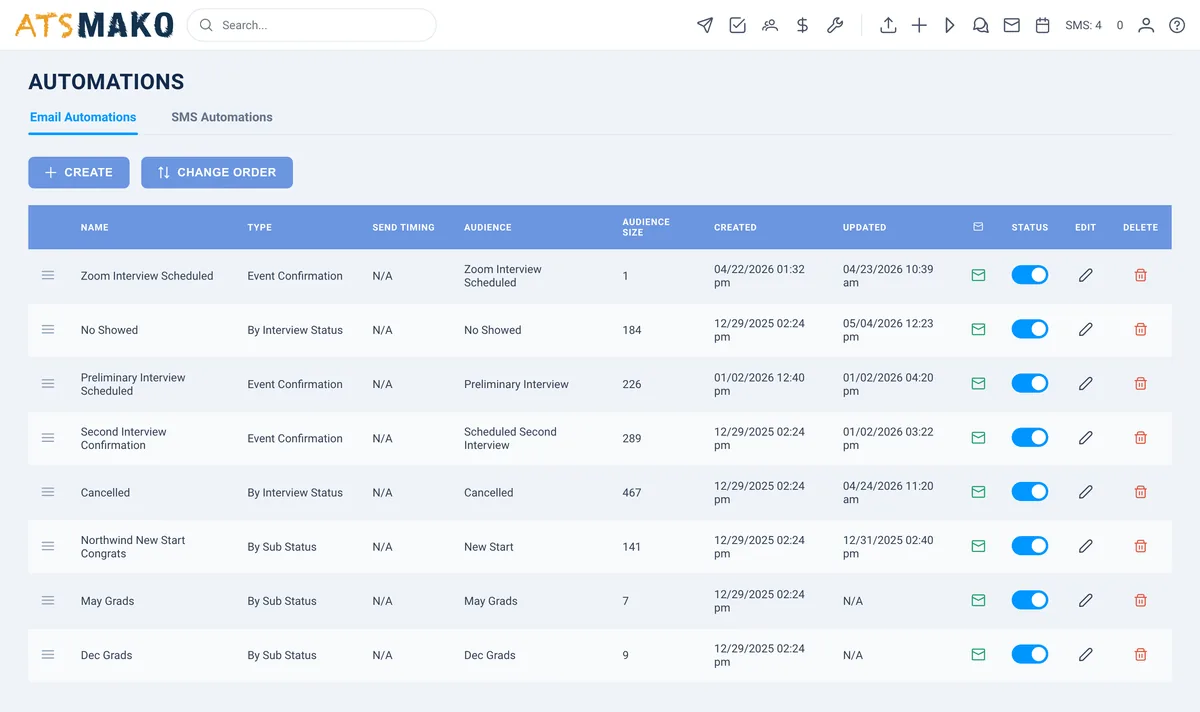
Set a status-triggered SMS and email to fire the instant a candidate enters the pipeline. Set the trigger, and we handle the rest - the first touch reaches every applicant in seconds, on every shift, without anyone at a desk.
Layer the AI voice screen as the second attempt
Configure an AI voice call to run after the opening messages. For engaged candidates it screens and scores; for quiet ones it becomes a live channel that SMS and email did not reach. Results flow straight into the pipeline for ranking.
Make follow-up conditional, never blind
Build the day-1, day-2, and day-4 touches with conditional logic so they fire only when there is no reply and stop the moment a candidate responds. Persistent without pestering - no double-messaging, no dropped candidates between touches.
Personalize at scale with merge fields and templates
Pull from a template library with dynamic merge fields like the first name, position, and interview time so every touch reads one-to-one at thousand-candidate scale. Update once, deploy everywhere, with lockable legal and EEO sections that stay intact.
Segment the cadence to the audience
Split candidates into dynamic audiences by role, location, or source and run the right cadence for each. A high-volume floor role gets a fast, SMS-heavy sequence; a specialist role gets more email detail and a human handoff sooner.
Read the signals and tune the sequence
Real-time engagement tracking shows opens, clicks, replies, and SMS delivery in a timestamped feed. Stop guessing, start knowing - see which touch converts, cut the ones that do not, and tighten the cadence over time.
One platform, every touch
All your channels, one pipeline
A cadence only works when every channel reports into the same record. In ATS Mako, the confirmation text, the detail email, and the AI voice screen all flow into one conversational inbox and one pipeline - so a recruiter sees the full story, not three siloed threads.
Real-time engagement tracking layers open, click, reply, and delivery signals over the sequence, so the cadence acts on what candidates actually do. Start your cadence with a high-volume hiring playbook or explore how it powers high-volume hiring at scale.
Fast, not reckless
Guardrails that keep the cadence compliant
A multi-channel cadence touches candidates more often, so the compliance rules matter more, not less. Build these in from touch one.
Every text needs lawful prior consent
Outbound recruiting SMS is regulated under the TCPA. Capture consent at the point of application, keep a clear opt-out such as "Reply STOP" on every automated text, and let the platform handle opt-outs automatically so a candidate who leaves stays gone.
Business hours only, even at 2am
A cadence that fires around the clock still respects quiet hours. Messages queue to business-hours sending so an applicant who applies at 2am gets their first touch at a reasonable time, not a middle-of-the-night ping.
Keep unsubscribe handling intact
Email touches carry automatic unsubscribe handling to stay compliant with CAN-SPAM. Never strip it, and never alter the lockable legal or EEO sections your team has approved inside the templates.
Every touch reinforces your brand
Your logo, your colors, your domain - across texts, emails, AI call scripts, and the Apply Here page. The candidate never sees ATS Mako. A multi-channel cadence should feel like one coherent brand, not three tools bolted together.
Questions, answered
Recruiting cadence FAQ
What is a recruiting cadence?
A recruiting cadence is an ordered, timed sequence of candidate touchpoints across channels - SMS, email, and AI voice calls - designed so each applicant hears from you at the right moment, on the channel they answer, from first apply to signed offer. Unlike a one-off blast, a cadence has a defined order, timing, and exit rules.
How many touches should a multi-channel cadence have?
For high-volume hiring, a tight sequence of roughly six to seven touches over four to five days works well: an instant SMS and email on apply, an AI voice screen a few hours later, then conditional follow-ups on days one, two, and four that only fire when there is no reply. Keep it short and let the cadence exit the moment a candidate responds.
Which channel should come first in the sequence?
Lead with SMS. Frontline and high-volume candidates read texts they never open in email, so an instant, status-triggered text is the fastest way to reach interest at its peak. Pair it with a parallel email that carries the detail, then layer the AI voice call as the second attempt.
How do you keep a cadence from pestering candidates?
Use conditional logic so every follow-up fires only when there is no reply and stops the instant the candidate responds. That keeps the cadence persistent without pestering, prevents double-messaging across channels, and respects business-hours-only sending and clear opt-outs.
Is a multi-channel recruiting cadence TCPA compliant?
It can be, when built correctly. Outbound recruiting texts need lawful prior consent, a clear opt-out on every message, automatic opt-out handling, and business-hours-only sending. Email touches must keep automatic unsubscribe handling intact. ATS Mako builds these guardrails into the automation so the cadence stays compliant as it scales.
Can ATS Mako run SMS, email, and AI calls in one sequence?
Yes. ATS Mako is a white-label platform where communication is the core, not an add-on. Status-, time-, and action-triggered automations orchestrate two-way SMS, multi-step email sequences, and AI voice screening in one cadence, all reporting into a single pipeline with real-time engagement tracking.
Stop chasing replies. Start orchestrating them.
Build one cadence across SMS, email, and AI calls on a white-label platform designed for speed and built for scale.
30-day free trial. Full feature access. No setup fees.