

Stop guessing. Start knowing.
The recruiter's guide to measuring delivery, response, reply, and opt-out rates by campaign, so every text you send earns its place in the pipeline.
30-day free trial. No setup fees, no long-term contracts.
A text you cannot measure is a text you cannot improve
Candidates answer texts they never open in email. That is exactly why recruiting SMS deserves the same scrutiny you give your best channel. Delivery, response, reply, and opt-out rates tell you which campaigns fill roles and which quietly burn your list. This is the measurement layer most teams skip, and the one that separates recruiters who guess from recruiters who know.
The six SMS metrics every recruiter should track
Report the same numbers the same way every time. Here is what each one means and how to calculate it.
Delivery rate
The share of texts that actually reached a handset. A low delivery rate points to bad numbers, landlines caught in a list, or carrier filtering long before a single candidate had the chance to reply. Read this first: every rate below it is only as trustworthy as this one.
Response rate
The share of reached candidates who texted anything back. This is the headline engagement number recruiters live and die by. Measure it against delivered, not sent, so undeliverable numbers do not quietly drag the figure down and hide a message that is actually working.
Reply rate vs. response rate
Not every reply is a good reply. Split raw responses into interested, not interested, and STOP. Reply rate measured on positive intent tells you whether the message is qualifying candidates or just provoking noise. A high response rate with low positive intent means the copy is loud, not effective.
Opt-out rate
The percentage who replied STOP or otherwise opted out. This is your early-warning system for message fatigue and list quality. A climbing opt-out rate is a signal to slow the cadence, tighten the audience, and revisit consent before it burns the list for good.
Link-click rate
When a text carries a link to an Apply Here page or a scheduling link, click rate shows whether the message drove action, not just acknowledgement. It separates candidates who said yes from candidates who actually moved a step forward.
Time to first reply
How fast candidates answer once a text lands. It tells you when your audience is awake and reading, so you can time campaigns to the windows that convert instead of texting into silence.
How to turn a rate into a decision
A number on its own is trivia. Read it the right way and it tells you exactly what to change next.
Always measure against delivered, not sent
A number divided by sent flatters or punishes you for list quality you already know about. Dividing reply, opt-out, and click counts by delivered isolates the thing you are actually testing: the message and the audience, not the phone list.
Read the rates as a funnel, top to bottom
Sent, then delivered, then responded, then positive intent, then action. When a campaign underperforms, the funnel shows where it broke. A drop between sent and delivered is a list problem. A drop between delivered and reply is a message problem.
Watch opt-out rate relative to response rate
A campaign that lifts responses while opt-outs stay flat is a genuine win. A campaign that lifts responses while opt-outs climb is borrowing against the list. Track both together, never one alone.
Segment before you conclude
One blended number hides the story. The same message can crush it for one role and flop for another. Break every rate out by campaign, requisition, audience segment, and send time before you decide what to change.
Directional targets, not guarantees
Use these as guardrails, then benchmark against your own rolling baseline. Every number below is illustrative and varies by role, market, and consent age.
| Metric | Weak | Healthy | Strong | Read it as |
|---|---|---|---|---|
| Delivery rate | Below 90% | 90% to 95% | Above 95% | Clean the list, filter landlines, and confirm carrier registration before blaming the copy. |
| Response rate | Under 20% | 25% to 45% | Above 45% | Directional only. Varies widely by role, market, and how recently consent was captured. |
| Positive reply rate | Under 10% | 15% to 30% | Above 30% | The number that matters for filling roles. Tag replies so you can measure intent, not noise. |
| Opt-out rate | Above 3% | 1% to 3% | Under 1% | Rising opt-outs mean too much, too often, or the wrong audience. Slow down before the list burns. |
| Link-click rate | Under 5% | 8% to 15% | Above 15% | A weak link rate usually means an unclear ask, not a broken link. Make the next step obvious. |
These bands are illustrative and offered as directional guidance only. ATS Mako does not guarantee any specific response, reply, or hiring outcome.
How to report SMS performance by campaign
Set the trigger. We handle the rest. Here is the five-step loop that turns raw sends into a report your team acts on.
Name and tag every campaign before you send
You cannot report on what you did not label. Give every blast, sequence, and status trigger a clear name and tie it to the role or audience it serves. A campaign with no name is a number you can never explain later.
Capture the raw counts automatically
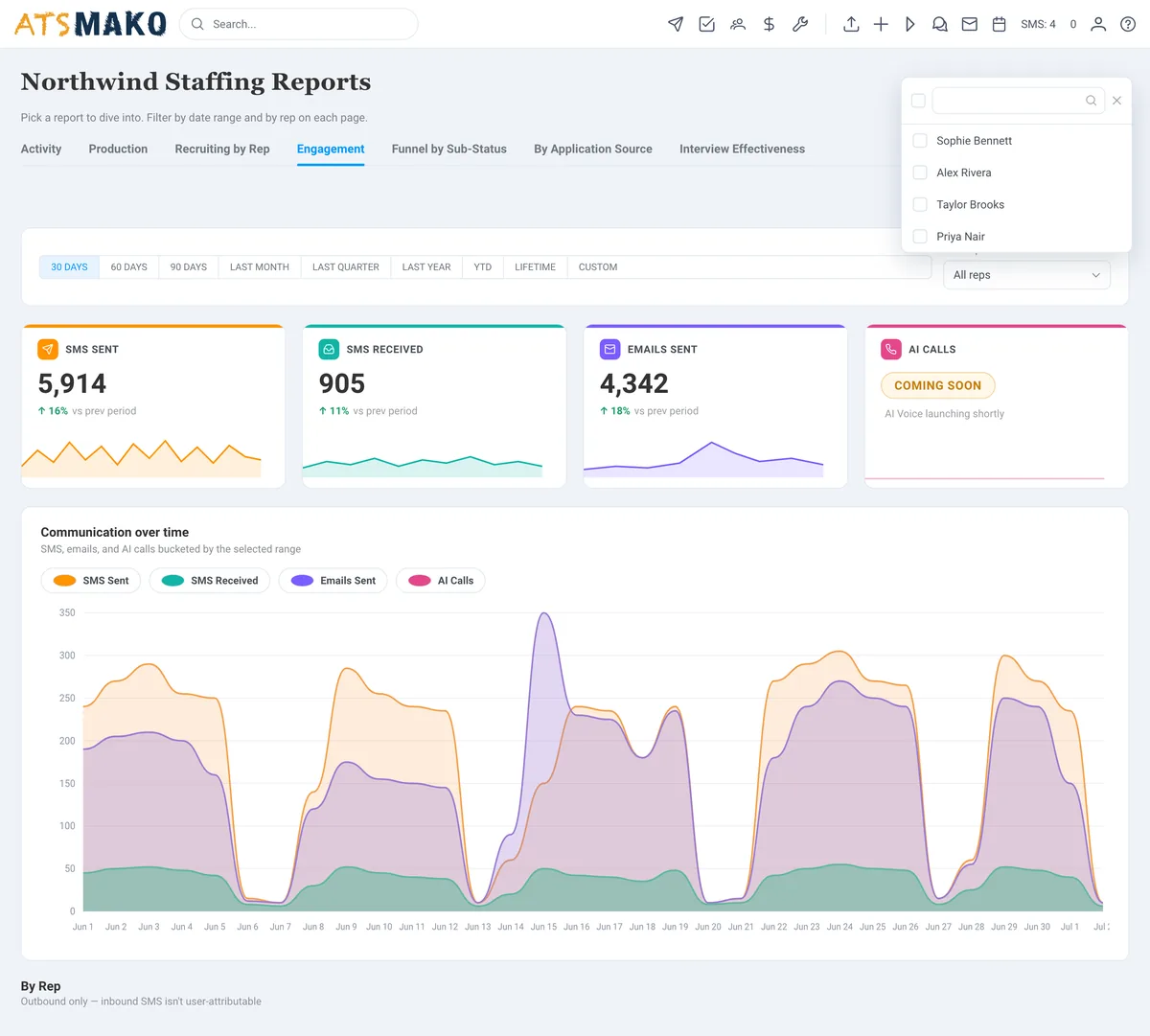
Delivery receipts, replies, link clicks, and opt-outs should log themselves. Real-time engagement tracking records who received, who replied, who clicked, and who opted out on a timestamped activity feed, so nobody is hand-counting from a phone.
Break every rate out by campaign and audience
Roll the raw counts into rates per campaign, per requisition, and per audience segment. That is how you learn that your second-touch text outperforms the first, or that one market opts out twice as fast as the rest.
Compare against your own baseline, then against targets
Your last four campaigns are the benchmark that matters most. Set a rolling baseline, then use directional targets as guardrails. A campaign is winning or losing relative to your own history, not a stranger's screenshot.
Turn the report into one next action
A report nobody acts on is a screenshot. Every review should end with a single decision: change the copy, tighten the audience, shift the send time, or pause a campaign that is bleeding opt-outs.
Every rate you track is also a promise you keep
SMS recruiting is regulated. The metrics that make you smarter are the same ones that keep you compliant.
Measure only what you had permission to send
SMS outreach in the US is regulated under the TCPA. Outbound texts need lawful prior consent. Track opt-in status as a metric of its own, and never let a campaign send to a segment whose consent you cannot show.
Honor STOP the instant it lands
Every automated text carries a clear opt-out such as Reply STOP, and automatic opt-out handling removes those candidates from future sends. Opt-out rate is not just a number to watch, it is a promise you are keeping in real time.
Send inside business hours
Quiet-hours protection queues texts to local business hours. It respects the candidate, keeps you compliant, and lands your message in a window where it can actually be read and replied to.
Four mistakes that make your SMS reporting lie
Measuring reply rate against sent instead of delivered
Undeliverable numbers water down a working message. Divide by delivered to see the true engagement of the candidates you actually reached.
Counting any reply as a win
A STOP is a reply. A wrong number is a reply. Tag responses by intent so your positive reply rate reflects candidates who want to talk.
Reading one blended number for everything
A single site-wide response rate hides the campaign that is quietly failing. Segment by campaign, role, and audience or the average will lie to you.
Ignoring opt-out rate until the list is dead
Opt-outs are the leading indicator of fatigue. By the time responses fall, you have already lost the audience. Watch STOPs first, not last.
Real-time engagement tracking does the counting for you
Most ATS platforms treat communication as an add-on. ATS Mako makes it the core. Delivery receipts, reply detection, link clicks, and opt-outs log themselves on a timestamped activity feed, and candidate replies land in one centralized conversational inbox.
- SMS delivery receipts and reply detection captured automatically.
- Break every rate out by campaign, requisition, and audience segment.
- Automatic opt-out handling and quiet-hours protection keep sends compliant.
- Customized reporting turns raw counts into a report your team acts on.
Recruiting SMS analytics, answered
What is recruiting SMS analytics?
Recruiting SMS analytics is the practice of measuring how your text-message outreach to candidates performs: delivery rate, response rate, positive reply rate, opt-out rate, link-click rate, and time to first reply, broken out by campaign, role, and audience. It turns texting from a guess into a system you can read, compare, and improve.
How do I calculate SMS response rate for a recruiting campaign?
Divide the number of candidates who replied by the number of texts that were delivered, not sent. Measuring against delivered removes undeliverable numbers from the math so the rate reflects the candidates you actually reached, and the message you actually tested.
What is a good opt-out rate for recruiting texts?
Directionally, an opt-out rate under 1% is strong and 1% to 3% is healthy, while anything above 3% is a warning to slow your cadence, tighten your audience, and revisit consent. These are illustrative targets, not guarantees, and they vary by role, market, and how recently consent was captured.
Why should I measure reply rate against delivered instead of sent?
Because dividing by sent punishes a good message for a bad phone list. If a quarter of your numbers never reached a handset, measuring against sent understates how well the message performed for the people who actually got it. Delivered isolates the message and the audience from list quality.
How does ATS Mako track SMS response and opt-out rates?
ATS Mako logs delivery receipts, replies, link clicks, and opt-outs automatically on a timestamped activity feed, so every rate is captured without hand-counting. Two-way SMS lands candidate replies in a centralized conversational inbox, and you can break performance out by campaign, requisition, and audience to see exactly what is working.
Do SMS analytics help keep recruiting texts TCPA compliant?
They support it. Tracking consent status, opt-out rate, and send timing gives you the visibility to prove permission, honor STOP requests, and keep sends inside business hours. ATS Mako pairs that with automatic opt-out handling and quiet-hours protection so compliance is built into the workflow, not bolted on after.
Message, move, and measure thousands of candidates
Designed for speed. Built for scale. See every reply, click, and opt-out in one white-label platform built for high-volume recruiting.
No setup fees. No long-term contracts. Free support and guided onboarding included.