Skip to content
ATS Mako

Recruiter's Guide

How Resume Parsing Actually Works

The plain-English breakdown of how an ATS reads a CV, why formats break accuracy, and how scoring turns thousands of resumes into one ranked shortlist - for recruiters running high-volume hiring.

30-day free trial. No setup fees, no long-term contracts.

The short version

From a page of prose to a ranked applicant record.

Resume parsing is the automated reading of a CV. Instead of a recruiter retyping a name, phone number, job titles, dates, and skills into a database, the parser extracts those fields straight from the file and builds a searchable applicant record - instantly.

That matters most at volume. When hundreds of resumes arrive across job boards, inbound email, and your Apply Here page, manual data entry is the first bottleneck to break. Parsing removes it. Then scoring ranks what parsing extracted, so you open your pipeline to a finished shortlist instead of a stack of PDFs.

Below, the full pipeline: how a file becomes data, why formatting decides accuracy, and how keyword and weighted scoring turn matches into a ranking you can trust.

The parsing pipeline

Five stages from file to shortlist

Every resume runs the same path. Understand each stage and you understand where accuracy is won - and where it is lost.

01

Ingest the File

Parsing starts the moment a resume lands - from a job board, an inbound email, a bulk upload, or your branded Apply Here page. The parser first identifies the file type (PDF, DOCX, RTF, plain text, or an image scan) and extracts the raw text layer. Native text-based PDFs and Word documents read cleanly. Scanned images and photos of resumes are harder: they require optical character recognition (OCR) before any words exist to work with, which is where accuracy first begins to slip.

02

Segment the Document

Once there is readable text, the parser breaks the resume into logical sections - contact details, work history, education, skills, certifications, and summary. It looks for headings, whitespace patterns, and layout cues to decide where one section ends and the next begins. A clean, single-column resume with standard headings segments almost perfectly. Multi-column layouts, tables, and creative designs confuse the reading order and are the number one cause of scrambled data.

03

Extract the Fields

Inside each section, the parser pulls structured fields: name, email, phone, job titles, employer names, employment dates, degrees, and skill keywords. It normalizes dates into a consistent format, links titles to employers, and calculates tenure. This is what turns a page of prose into a searchable, sortable applicant record - no retyping, no copy-paste, no missed applications.

04

Score Against Your Criteria

Extraction alone tells you what is in a resume. Scoring tells you how well it matches the role. The parser compares the extracted data against your keywords, required skills, titles, and experience thresholds, then produces a match score. In ATS Mako, that score is built on your criteria, not ours - you set the keywords and the weighting, and the AI ranks every applicant against them.

05

Rank and Shortlist

The final stage stacks every scored candidate into a ranked shortlist. Instead of reading resumes one by one, you open your pipeline to finished work - the strongest matches surfaced at the top, the weakest filtered down. Combine that with engagement scoring (who opened, clicked, and replied) and you are prioritizing the candidates most likely to convert, not just the ones with the right keywords.


Why accuracy varies

The resume decides the accuracy, not just the parser

The same engine that reads one resume flawlessly can garble another. The difference is almost always the file: its format, its layout, and how the content is placed.

Input type Reads What happens
Native PDF / DOCX Excellent Text-based Word and PDF files carry a clean text layer the parser reads directly. Standard headings and a single-column layout give near-perfect extraction.
Scanned image / photo Fragile A photographed or scanned resume has no text layer. OCR must reconstruct the words first, and any blur, skew, or low resolution introduces errors before scoring even begins.
Multi-column layout Risky Two- and three-column designs scramble the reading order. Skills can land inside job history, and dates can detach from employers - the leading cause of garbled applicant records.
Tables and text boxes Risky Content placed inside tables, headers, footers, or floating text boxes is often skipped or misread. Contact details tucked into a header frequently go missing.
Graphics and icons Ignored Skill bars, rating dots, logos, and infographic elements carry no machine-readable text. A skill shown only as a progress bar is invisible to the parser.
Non-standard headings Weak Creative section labels like "Where I have made an impact" confuse segmentation. Plain headings - Experience, Education, Skills - parse far more reliably.

Rule of thumb for candidates and recruiters alike: single column, standard headings, real text, no graphics. That formatting parses cleanly across virtually every ATS.

How scoring works

Parsing tells you what. Scoring tells you who to call first.

A match score stacks candidates by fit. Layer engagement on top and you are ranking by momentum too - built on your criteria, not ours.

Keyword matching

Does the resume contain what the role requires

The simplest layer of scoring. The parser checks whether required terms - specific skills, tools, certifications, or titles - appear in the resume. Fast and transparent, but blunt on its own: it rewards presence, not depth, and can miss synonyms unless your keyword list accounts for them.

Weighted criteria

Which requirements matter most

Not every requirement is equal. Weighting lets you tell the system that a specific certification outweighs a nice-to-have tool, or that recent, relevant tenure counts more than years alone. In ATS Mako you set custom weighting, so the ranking reflects how you actually hire for the role - not a generic template.

Experience and tenure

How much and how relevant

Scoring reads the extracted dates and titles to gauge total experience and time in relevant roles. A five-year veteran in the exact function scores above a generalist with a longer but unrelated history - assuming the dates parsed cleanly, which is why format hygiene matters.

Engagement scoring

Who is actually responsive

A resume score tells you fit. Engagement scoring tells you momentum. ATS Mako layers real-time signals - opens, clicks, replies, and SMS activity - onto the ranking so you prioritize candidates who are both qualified and actively responding, the ones most likely to close.

Inside ATS Mako

Ranked shortlists, built on your criteria

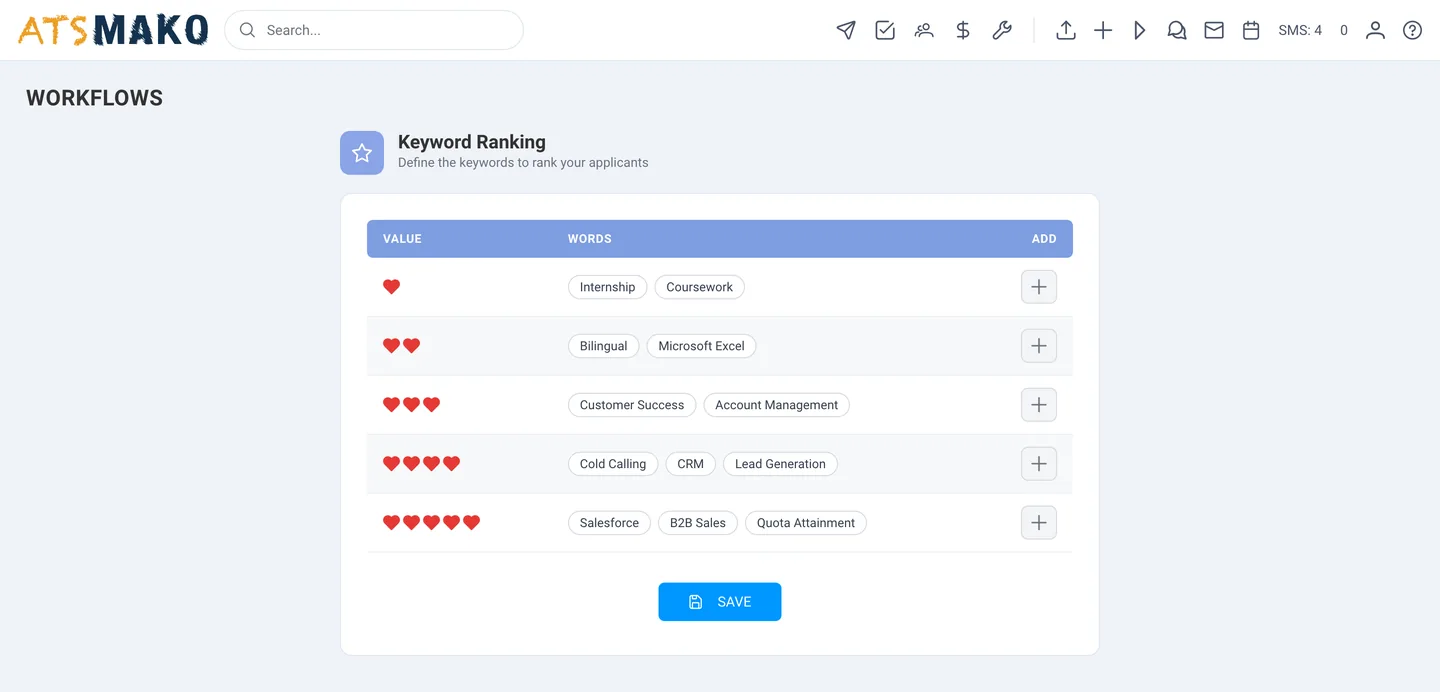
ATS Mako parses every incoming resume, extracts the fields, and scores each applicant against the keywords and weighting you set for the role. The strongest, most responsive candidates rise to the top - so recruiters open their pipeline to finished work.

AI candidate ranking sits alongside AI voice and call screening in the platform's AI and Candidates toolset, so you can parse, rank, and screen without leaving one branded system. Ranking on your criteria means the human still defines what good looks like.

ATS Mako AI candidate ranking with keyword scoring, showing applicants ranked against configured criteria

Where parsing fits

One platform instead of a bolted-on parser

A standalone resume parser is one of the nine disconnected tools most teams juggle. When parsing lives inside your ATS, the ranked record flows straight into capture, communication, scheduling, and reporting - no exports, no re-imports, no silos.

Capture feeds parsing

Applicants arrive from job boards, portals, inbound email, and your branded Apply Here page. Every submission becomes a parsed record instantly, with smart source and job-posting matching.

Parsing feeds ranking

Extracted fields flow into AI scoring against your keywords and weighting, producing an intelligent shortlist the moment resumes land.

Ranking feeds outreach

Your top matches move straight into two-way SMS and email automations, so the best candidates hear from you first - from first touch to offer letter.

FAQ

Resume parsing, answered

The questions recruiters ask before they trust a machine to read their pipeline.

What is resume parsing?
Resume parsing is the automated process an applicant tracking system uses to read a resume and turn its contents into structured, searchable data. Instead of a recruiter manually retyping a name, contact details, job titles, dates, and skills into a database, the parser extracts those fields directly from the file and creates an applicant record automatically. It is the technology that lets a high-volume team turn thousands of inbound resumes into an organized, sortable pipeline without manual data entry.
How accurate is resume parsing?
Accuracy depends far more on the resume than on the parser. A clean, single-column, text-based PDF or Word document with standard section headings extracts with very high accuracy. Accuracy drops with scanned images that require OCR, multi-column layouts that scramble reading order, content trapped in tables or headers, and skills shown only as graphics. The most reliable results come from formatting hygiene on the applicant side plus a parser that handles common file types well - which is why the strongest workflows pair automated parsing with a quick recruiter review of the top shortlist.
What resume formats parse best?
Native, text-based PDFs and standard Word documents (DOCX) parse best. They carry a clean text layer, so the parser reads them directly without OCR. Within those formats, a single-column layout, standard section headings (Experience, Education, Skills), plain text instead of tables or text boxes, and real text instead of graphic skill bars all improve extraction. Photos or scans of printed resumes are the weakest input because they have no text layer and depend on OCR before parsing can even begin.
What is the difference between resume parsing and CV scoring?
Parsing and scoring are two stages of the same pipeline. Parsing is extraction: reading the resume and converting it into structured fields like titles, dates, and skills. Scoring is evaluation: comparing that extracted data against the requirements of a specific role to produce a match ranking. Parsing tells you what is in the resume; scoring tells you how well it fits the job. ATS Mako runs both, then stacks the results into a ranked shortlist built on the keywords and weighting you define.
Does resume parsing replace recruiters?
No. Parsing and scoring remove the manual grind - data entry and first-pass triage across a large volume of applicants - so recruiters spend their time on judgment, conversation, and closing. The AI surfaces the strongest matches; the recruiter decides. ATS Mako is built on the principle of ranking on your criteria, not ours, so the human stays in control of what good looks like while the machine handles the reading at scale.
How does ATS Mako score candidates?
ATS Mako parses each incoming resume, extracts the structured fields, and then scores every applicant against the keywords, skills, and weighting you configure for the role. It combines that resume match score with engagement signals - email opens, link clicks, replies, and SMS activity - to produce a ranked, intelligent shortlist. You set the criteria; the platform ranks against them and keeps the strongest, most responsive candidates at the top of your pipeline.

Stop reading. Start ranking.

Let the parser read every resume. You close the best ones.

Parse, score, and rank thousands of candidates on your criteria - inside one fully branded platform.

Designed for speed. Built for scale. No setup fees, no long-term contracts.