
Skip to content
ATS Mako
Recruiting Benchmarks · 2026

Know What a Good Recruiting Email Looks Like

The 2026 open, click, reply, and bounce-rate benchmarks for candidate email - plus how high-volume recruiting teams actually hit them.

30-day free trial. No setup fees, no long-term contracts.

Why this matters

Stop guessing whether your numbers are good.

You send a campaign to a fresh pool of applicants, watch the opens tick up, and wonder: is a 38% open rate strong, or should you be worried? Without a benchmark, every number is just a number. This is the reference you can hold your recruiting email program against in 2026 - what typical looks like, what strong looks like, and which metric to actually chase.

A quick note on the numbers below: the ranges are directional bands drawn from how candidate-facing recruiting email tends to behave, not guaranteed outcomes. Your industry, list quality, timing, and sender reputation will move them. Use them to calibrate, then measure your own baseline and beat it.

The 2026 benchmarks

Candidate email at a glance

Directional bands for recruiting email. Find your metric, find your band, then work up a column.

Metric Needs work Good Strong What drives it
Open rate Under 25% 35% - 45% 50%+ Candidates open recruiting mail more than the average marketing list - the message is about them and their next job.
Click-through rate Under 2% 4% - 8% 10%+ A single, obvious action (apply, book a time, confirm) beats a wall of links every time.
Reply rate Under 2% 5% - 12% 15%+ Reply rate is the metric that actually predicts hires. Opens feel good; replies move a pipeline.
Bounce rate Over 5% Under 3% Under 1% High bounce rates poison your sender reputation and quietly drag every future send into spam.
Unsubscribe rate Over 1% Under 0.5% Under 0.2% Keep it near zero by only emailing candidates who applied or opted in, and by keeping the exit obvious.

Illustrative ranges for calibration. Measure your own baseline and beat it.

Read the metrics right

Not every number deserves your attention equally

Open rate

What it tells you (and what it hides)

Open rate measures whether your subject line and sender name earned attention - but privacy features and image-blocking make raw open numbers noisier than they used to be. Treat opens as a directional health check for deliverability and subject lines, and let click and reply rate carry the weight when you judge a campaign.
Click and reply rate

The metrics that actually predict hires

Clicks and replies are intent you can bank on. A candidate who books a screen or texts back is in your pipeline; a candidate who merely opened is not. Optimize the whole program toward the reply: one clear ask, fast timing, and a follow-up that fires only when the candidate goes quiet.

Bounce and unsubscribe

The numbers that protect every future send

Bounces and complaints are the metrics your email provider watches to decide whether you belong in the inbox or the spam folder. Keep bounces under 3%, keep unsubscribe handling automatic and instant, and your good open rates stay good next quarter instead of decaying.

How good gets made

Four levers that move every metric above

Benchmarks tell you where you stand. These tell you how to climb.

01

Deliverability comes first

The best subject line in the world is worthless in the spam folder. Authenticate your domain (SPF, DKIM, DMARC), warm your sending, and prune dead addresses so your open rate reflects real interest, not just inbox placement.

02

Speed beats polish

Candidates apply to many roles at once. An email that lands within minutes of an application gets read; one that lands the next morning competes with everyone who moved faster. Status-triggered sends close that gap automatically.

03

One message, one action

A recruiting email should ask for exactly one thing - apply, book a screen, confirm an interview. Every extra link splits attention and drops your click and reply rates.

04

Follow up without nagging

Most replies come after the first email, not on it. A conditional sequence that auto-follows-up only when there is no reply lifts total reply rate without burning your list.

Measure it in one place

Track open, click, and reply rates without stitching tools together

Most ATS platforms treat communication as an add-on. ATS Mako makes it the core. Every email you send is tracked in real time - opens, link clicks, replies, and delivery receipts land on a timestamped activity feed, so you see which campaigns actually move candidates and which quietly die.

  • Multi-step email sequences with conditional logic - auto follow-up fires only when there is no reply.
  • Real-time engagement tracking - open, click, and reply detection with instant recruiter alerts.
  • Automatic unsubscribe handling keeps you CAN-SPAM compliant on every send.
  • 50+ templates with dynamic merge fields like the candidate name, position, and interview time.
  • Unified inbox pairs email with two-way SMS to recover candidates email alone never reaches.

Update a template once and deploy everywhere. Keep every message on your logo, your colors, your domain - your brand, codified.

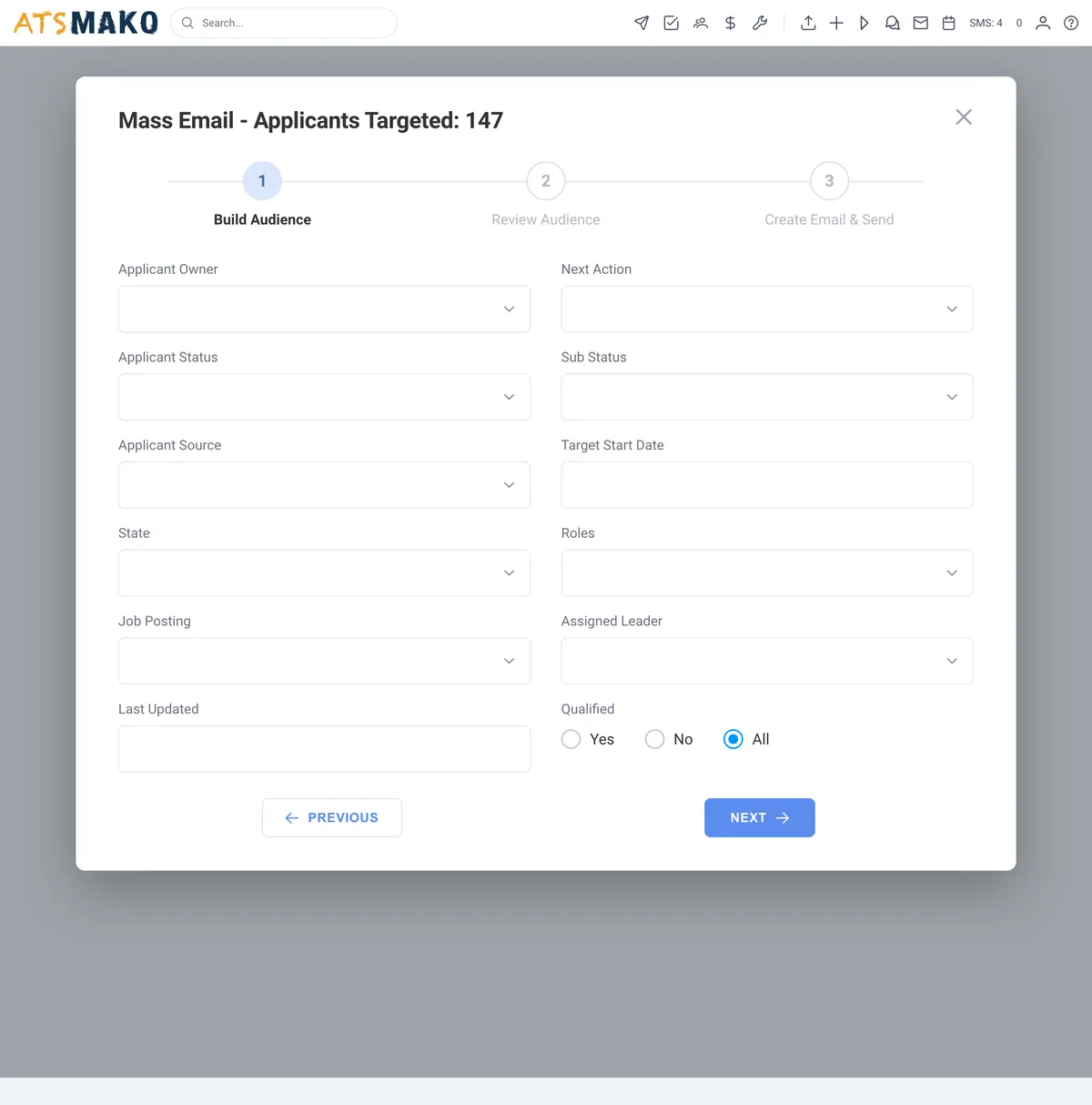
ATS Mako mass email builder showing a multi-step recruiting sequence with open, click, and reply tracking
Straight answers

Recruiting email benchmark FAQs

What is a good email open rate for recruiting in 2026?

For candidate-facing recruiting email, a healthy open rate typically lands in the 35% to 45% range, with strong programs clearing 50%. Recruiting email tends to outperform generic marketing email because the message is personally relevant - it is about the candidate's own application and next role. Treat these as directional bands, not guarantees; deliverability, list quality, and timing move the number more than any single subject line.

What matters more - open rate or reply rate?

Reply rate. Opens confirm your subject line and sender reputation earned attention, but privacy features make raw open data noisy, and an open never filled a role. A reply - a booked screen, a confirmed interview, a text back - is real pipeline movement. Judge campaigns on clicks and replies, and use open rate as a deliverability health check rather than the headline metric.

Why are my recruiting emails landing in spam?

The usual culprits are missing domain authentication (SPF, DKIM, DMARC), sending to stale or purchased lists that bounce, and stripping the unsubscribe option. Fix authentication, prune dead addresses to keep bounces under 3%, keep automatic unsubscribe handling intact for CAN-SPAM, and warm new sending domains gradually. ATS Mako keeps unsubscribe handling automatic and tracks delivery so you catch placement problems before they tank a whole campaign.

How do I improve email reply rates from candidates?

Send fast (status-triggered emails that fire the moment an application lands), ask for exactly one action, personalize with dynamic merge fields like the candidate's name and the role, and layer in a conditional follow-up that only sends when there is no reply. For time-sensitive, high-volume roles, pairing email with two-way SMS in the same conversational inbox recovers the candidates email alone never reaches.

How does ATS Mako help me hit these benchmarks?

ATS Mako builds communication into the core of the platform, not as an add-on. You get multi-step email sequences with conditional logic, real-time open, click, and reply tracking, automatic unsubscribe handling, a 50+ template library with dynamic merge fields, and a unified inbox that pairs email with two-way SMS. You measure open, click, reply, and bounce rates in one place and act on them without stitching together separate tools.

One platform. Every hire.

Build a faster, smarter hiring engine - fully branded to you.

Stop guessing your numbers. Track open, click, and reply rates in one platform that unifies email, two-way SMS, AI ranking, scheduling, and reporting.

Designed for speed. Built for scale.