
Avionte alternatives for high-volume staffing
If your bottleneck is filling shifts rather than invoicing them, here is how to evaluate what comes next - the questions that matter at volume, and an honest account of when to stay where you are.
Last reviewed: August 2026. Verify current vendor details directly with each vendor.
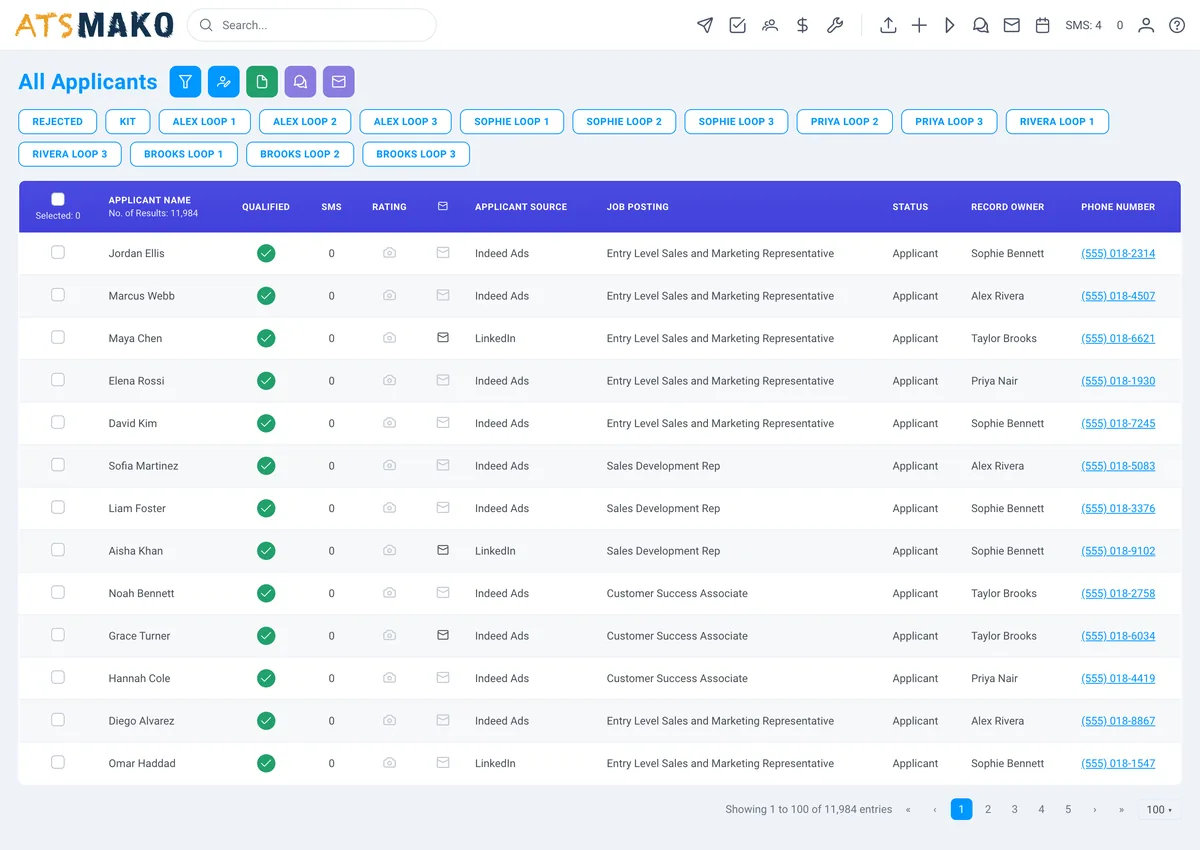
Filter to a segment, then act on all of it at once
Is the platform your constraint?
If you are searching for alternatives, you already have a reason. Naming it precisely matters, because it determines whether changing platform actually solves it.
The bottleneck agencies most often describe is this: shifts go unfilled not because the back office is weak, but because 300 applicants arrived overnight and nobody could work through them fast enough.
If your constraint is fill speed rather than invoicing, the platform question becomes: how much of the first 24 hours can the system handle without a human touching each record?
The number to check: of everyone who applied yesterday, what share received a real response within 24 hours? Under 50% at volume is a systems problem, not an effort problem.
Six questions for every vendor on your shortlist
Ask these of Avionte, of us, and of anyone else you are considering. Identical questions, written answers, side by side.
The first 24 hours
Ask: When 300 people apply to one warehouse req overnight, what happens automatically before a recruiter logs in? Ranking, auto-text, screening calls, disqualification on knockout answers?
Why it matters: High-volume hiring is decided in the first day. Applicants who wait 48 hours for a reply have already taken another job.
ATS Mako’s answer: Applicants are parsed and ranked on your criteria, automated SMS goes out on application, and AI voice screening can call the shortlist without a recruiter dialling.
Bulk action at real scale
Ask: Can a recruiter filter to a segment and act on all of it at once - message, advance, disqualify, schedule? What is the practical ceiling before it gets slow?
Why it matters: Moving records one at a time is the hidden cost of volume hiring. It is where recruiter hours actually go.
ATS Mako’s answer: Bulk actions run across a filtered list - message, advance, reject or schedule hundreds of records in one pass.
Shift and multi-location structure
Ask: Can you run reqs per branch or per site with location-scoped permissions, and can a regional manager see across all of them?
Why it matters: Light-industrial staffing is geographically messy. A single flat candidate pool creates cross-branch chaos.
ATS Mako’s answer: Location-scoped roles and permissions, with roll-up visibility for regional and leadership views.
Text-first candidate contact
Ask: Is SMS native and two-way, with replies landing on the record? Are consent and opt-out captured automatically?
Why it matters: Hourly and shift workers answer texts, not emails. If texting sits outside the ATS, your record and your consent trail are both incomplete.
ATS Mako’s answer: Two-way SMS is core, threaded onto the candidate record, with consent and opt-out state captured on the profile.
Pricing transparency
Ask: Ask for the all-in annual figure: licence, implementation, migration, SMS and telephony usage, integrations, seat minimums, renewal uplift.
Why it matters: At volume, per-message and per-minute usage costs stop being rounding errors. Model them at your real send volume.
ATS Mako’s answer: Our current plans and terms are published on our pricing page rather than quoted case by case.
Redeployment
Ask: How does the system surface workers finishing assignments so you can redeploy them instead of re-sourcing?
Why it matters: Redeploying a known worker is dramatically cheaper than filling from cold. Most agencies do it late or not at all.
ATS Mako’s answer: Segment by assignment end date and run automated re-engagement before the assignment closes.
Three things built for shift-filling speed
The first day is automated, not staffed
The difference between filling a shift and losing it is usually measured in hours. Ranking on arrival, automatic text on application, and AI voice screening mean the pile is triaged before your recruiters open their laptops - so the people they call are the ones worth calling.
Hundreds of records, one action
Volume hiring punishes per-record work. Filter to "applied in the last 24 hours, passed knockout questions, within 20 miles" and message, advance or schedule the entire segment in one pass. The hours saved are not marginal - they are the job.
Your brand on every touch
Light-industrial candidates often work for several agencies. Full white-label - portal, application, SMS sender, offer - means the worker knows which agency is texting them, which is exactly why they reply to you and not the other one.
When staying where you are is the right call
Four situations where we would tell you not to switch.
Integrated pay/bill is your operational core
If timesheets, payroll and invoicing run through your ATS, replacing it is a finance and operations project. The bar for switching should be much higher, and the evaluation should start with your controller, not your recruiters.
Onboarding compliance packets are complex
Light-industrial onboarding carries real compliance weight - I-9, WOTC, safety acknowledgements, client-specific packets. Rebuilding that configuration is genuine work. Inventory it before you shop.
You have deep client-specific configuration
Years of per-client rules, custom fields and reporting have value. Some of it resets on a migration, and that cost is legitimate.
Your fill rates are already strong
If you are filling shifts on time and your recruiters are not drowning, the platform is not your constraint. Spend the budget somewhere it moves a number.
Volume-hiring questions, answered.
Why is there no side-by-side vendor feature table on this page?
Because we are not able to verify another vendor's current capabilities and pricing to a standard worth publishing. Features change, contract tiers differ, and many staffing platforms do not publish list pricing. Publishing a confident-looking table of unverified claims about a competitor is how most "alternatives" pages mislead people. What we publish instead is the evaluation framework - the questions that actually separate platforms at volume - along with our own answers in full. Ask both vendors the same questions in writing and you get a comparison that is accurate on decision day.
How does ATS Mako handle 300 applicants on one requisition?
Applications are parsed and ranked against criteria you set for that req - shift availability, location radius, certifications, knockout answers. Automated SMS acknowledges every applicant immediately, AI voice screening can call the ranked shortlist, and bulk actions let a recruiter advance, reject, message or schedule the whole filtered segment at once. The practical measure is what share of yesterday's applicants got a real response today.
Can we run separate branches or locations?
Yes. Requisitions and candidate access can be scoped by location with role-based permissions, so a branch manager sees their own pipeline while regional and leadership roles get roll-up visibility across sites. Multi-location recruiting is covered in more depth on our multi-location page.
What does migrating actually take?
Plan four to six weeks for a small to mid-size agency: one to two weeks to export and map data, a week to configure pipelines, fields and templates, one to two weeks running parallel on live reqs, then a validation week. The main variable is how much history you bring and how clean it is.
Does SMS usage cost extra at high volume?
Messaging and telephony carry usage costs on every platform, ours included - that is the underlying carrier reality, not a vendor policy. The right move in any evaluation is to model your actual monthly send volume and get the all-in number in writing from each vendor. Ask specifically about per-segment message pricing and per-minute voice pricing, because at volume those lines matter more than the licence.
Do we keep our existing phone numbers?
Raise this early with every vendor, including us. Candidates reply to the number they recognise, and portability depends on the platform and the carrier. It is a small question that becomes a large problem at cutover if nobody asked it.
Next steps in your evaluation
Note on vendor names. All product and company names are the trademarks of their respective owners and are used here only to identify the products a reader may be comparing. ATS Mako is not affiliated with, endorsed by, or sponsored by any other vendor referred to on this page. This page makes no representations or warranties about any other vendor’s features, pricing, performance or suitability - confirm those directly with the vendor concerned. Content is general information current as of the last-reviewed date, is not advice, and should not be relied on as the sole basis for a purchasing decision.
Put one high-volume req through it.
30-day free trial. Post one warehouse or call-centre role and measure how many applicants get a real response in 24 hours.
30-day free trial · No setup fees · No long-term contracts