
There is no best ATS. There is a best ATS for your hiring shape.
Every "top 10 ATS" list ranks products that solve different problems. This one sorts by the only thing that actually decides the answer: how you hire.
Last reviewed: August 2026. Vendor capabilities change - verify current details directly with each vendor.
Find your hiring shape first
Work out which of these describes you before you look at a single product. It narrows a shortlist faster than any feature list, and it is the one thing no vendor can tell you.
High-volume hourly and shift hiring
You know it is you if: You post a req and 200-500 people apply. Fill speed is the whole game, and most applicants never hear back.
What actually matters: Automated first contact, ranking on arrival, AI phone screening, bulk action on filtered segments, SMS as the primary channel.
High-volume ATS →Staffing and recruiting agencies
You know it is you if: You place candidates with client companies. Your brand, your margin and your client relationships are the business.
What actually matters: White-label branding, client-facing portals, submission workflow, bill/pay rate visibility, redeployment of known workers.
Staffing agency software →IT and contract staffing
You know it is you if: Long sales cycles, technical screening, bench management and contract renewals define your quarter.
What actually matters: Stack-level skills matching, bench re-engagement, contract-to-hire pipelines, margin per placement, VMS submission fit.
IT staffing software →Multi-location and franchise systems
You know it is you if: Ten, fifty or three hundred locations hiring the same roles, with local managers and central oversight.
What actually matters: Location-scoped permissions, roll-up reporting, per-brand or per-unit branding, centralised templates with local autonomy.
Franchise & multi-brand →Corporate HR and in-house talent teams
You know it is you if: Steady req volume, internal stakeholders, structured interview processes and compliance reporting.
What actually matters: HRIS and payroll integration, interview scheduling, offer and e-signature, EEO and diversity reporting, SSO.
Enterprise HR teams →Four axes worth more than any feature list
Feature checklists converge - nearly every vendor ticks nearly every box. These four are where platforms genuinely diverge.
Is communication in the core, or bolted on?
This is the single most consequential difference in 2026 and the one most buyers underweight. If two-way SMS lives in a separate tool, three things follow: your activity history is incomplete, your consent trail is scattered, and your recruiters spend their day in an app you did not evaluate. Ask every vendor where a candidate reply physically lands, and who can see the thread.
What happens in the first 24 hours, without a human?
Every platform can store an application. The difference is what the system does with 300 of them overnight. Ranking against your criteria, automatic acknowledgement, knockout-question disqualification and AI phone screening are the difference between triage and a backlog. Ask for the demo to start with a bulk import, not a single tidy candidate.
Whose brand does the candidate see?
For agencies and platforms this is commercial, not cosmetic. Career portal, application form, SMS sender ID, offer letter, notification emails - each one is either your brand or your vendor's. Ask exactly which surfaces can be white-labelled and what it costs, because the answer varies enormously.
What is the real all-in cost, and can you leave?
Licence price is the beginning. Implementation, migration, SMS and telephony usage, integration fees, seat minimums and renewal uplift are where the number actually forms. And ask the exit question early - what you can export and who owns your phone numbers - because the answer tells you how a vendor thinks about the relationship.
Evaluating a specific platform?
Each guide covers the questions to ask, what a switch costs, and an honest account of when staying put is the better decision.
Bullhorn alternatives
For staffing agencies weighing a move off the category incumbent.
Read the guide →
Ceipal alternatives
For IT and contract staffing teams where response time is the bottleneck.
Read the guide →
Avionte alternatives
For light-industrial agencies whose constraint is fill speed, not invoicing.
Read the guide →
How to run the evaluation
Four steps that keep the decision honest and stop it turning into a demo beauty contest.
Name your hiring shape
Before you look at a single vendor, write down your volume per month, your applicant-to-req ratio, your locations, and whether you place with clients or hire in-house. Most bad ATS decisions come from evaluating against someone else's hiring shape.
Write the questions once
Build one question list and send it to every vendor in writing. Identical questions produce a comparison you can defend. Our RFP template and scorecard covers the areas most buyers forget.
Demo with your data, not theirs
Insist on a trial or a demo seeded with a realistic applicant volume. A polished demo with six candidates tells you nothing about a Monday morning with three hundred.
Score, then check the exit
Weight your scorecard before the demos so enthusiasm cannot rewrite it afterwards. Then confirm export terms and number ownership in writing before signing.
Where ATS Mako fits
This is our website, so treat the rest of this page as the useful part and this section as the pitch - clearly labelled.
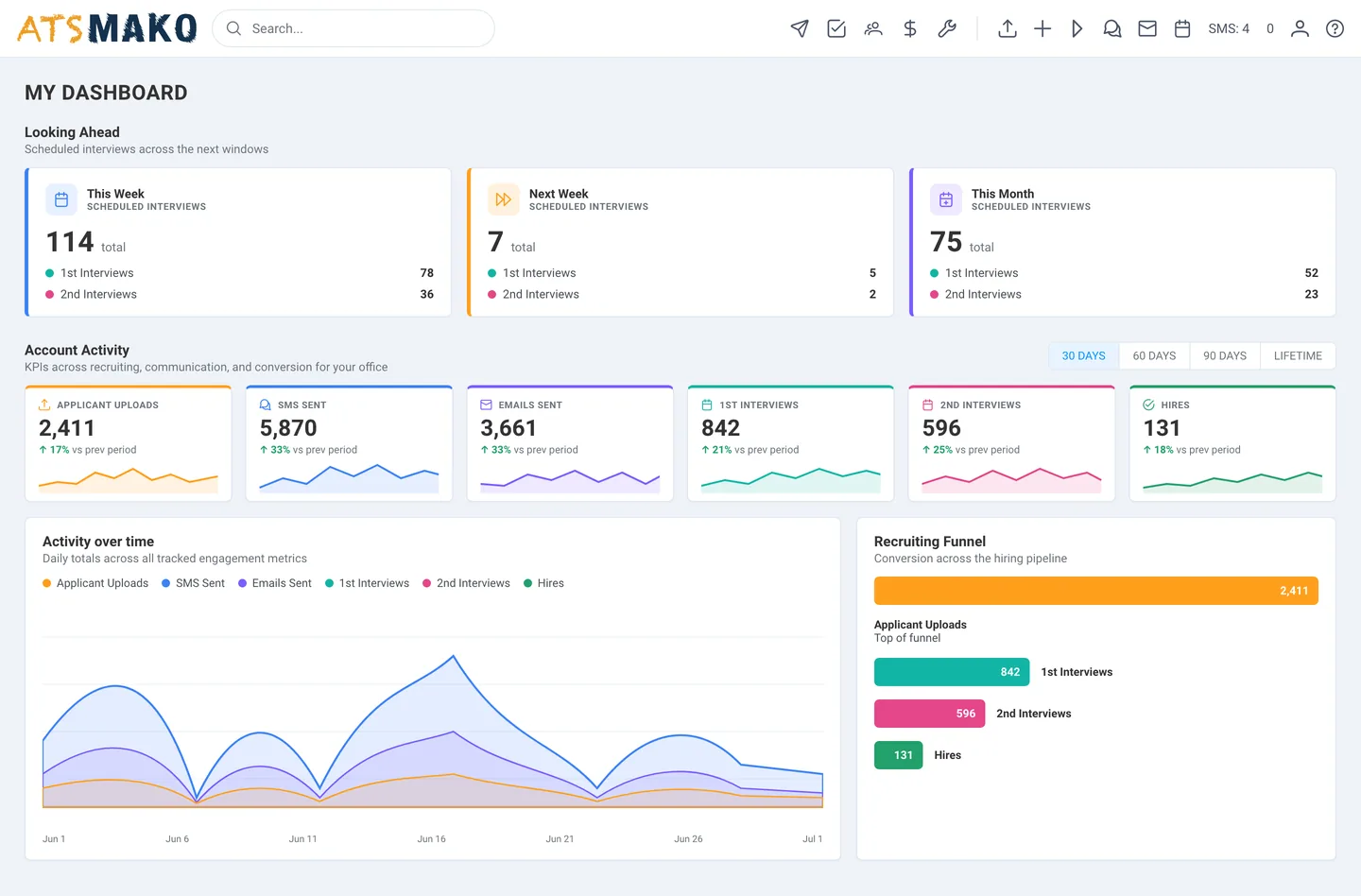
ATS Mako is built for organisations whose bottleneck is candidate contact at volume: staffing agencies, high-volume hourly hiring, franchise and multi-location systems, and platforms that need to offer recruiting under their own brand. Two-way SMS and email are in the core rather than bolted on, AI ranking and AI voice screening handle the first pass, bulk actions move hundreds of records at once, and the whole candidate experience is white-labelled to you.
We are a weaker fit if your primary need is deep integrated pay/bill and back-office finance, if most of your volume flows through enterprise VMS and MSP programmes, or if you hire a small number of highly specialised people a year where sourcing - not response time - is the constraint. In those cases another platform will serve you better, and we would rather say so here than six weeks into an implementation.
Choosing an ATS, answered.
Why does this page not rank the platforms from best to worst?
Because a forced ranking would be dishonest. The best ATS for an agency filling 400 warehouse shifts a month and the best ATS for a corporate team hiring 30 engineers a year are not the same product, and no ordering of them is meaningful. What we can do is give you the axis that actually decides it - your hiring shape - and the questions that separate platforms once you know it. Any page that hands you a numbered ranking without asking about your volume, your locations or your business model is selling something.
Why are there no feature comparison tables or prices for other vendors here?
We do not publish claims about other companies' products that we cannot verify to a standard we would stand behind. Capabilities change, pricing tiers differ by contract, and many platforms in this category do not publish list pricing at all. Rather than fill a table with confident guesses, we publish the evaluation framework and our own answers in full. Send the same questions to every vendor and you will have a comparison that is accurate on the day you decide - which is worth more than anything we could write about a competitor.
How many vendors should we shortlist?
Three is usually right, four at most. Below three you have no comparison; above four the evaluation collapses under its own weight and you end up choosing on demo quality rather than fit. Sort by hiring shape first, and the list narrows itself quickly.
How long should an ATS evaluation take?
Four to eight weeks is a reasonable window for most small and mid-size organisations: a week to define requirements, two to three weeks of demos and trials, a week to check references and exit terms, and a week to negotiate. Rushing it produces a platform your recruiters route around; dragging it out produces a decision nobody remembers the reasons for.
What is the most common mistake in choosing an ATS?
Evaluating on features rather than on the daily path. Feature lists converge - almost every platform will tick almost every box. What differs is how many clicks it takes to move 200 candidates forward, where a text reply lands, and whether an admin can change a pipeline stage without raising a support ticket. Test the boring, repeated actions, not the impressive ones.
Should we consider switching if our current system mostly works?
Probably not. A migration costs four to six weeks of attention and resets some configuration you have already paid for. The honest threshold is whether a specific, measurable number is being held back by the platform - candidate response rate, time to fill, cost per hire - and whether you have already tried to move that number inside what you own. If you have not tried, start there.
Note on vendor names. All product and company names are the trademarks of their respective owners and are used here only to identify the products a reader may be comparing. ATS Mako is not affiliated with, endorsed by, or sponsored by any other vendor referred to on this page. This page makes no representations or warranties about any other vendor’s features, pricing, performance or suitability - confirm those directly with the vendor concerned. Content is general information current as of the last-reviewed date, is not advice, and should not be relied on as the sole basis for a purchasing decision.
Compare us the same way you compare everyone else.
30-day free trial, no setup fees. Run one real requisition end to end and judge it on the numbers.
30-day free trial · No setup fees · No long-term contracts