
Bullhorn alternatives, evaluated honestly
No invented feature table, no cherry-picked screenshots. The questions that actually separate staffing platforms, what a switch really costs, and a straight answer on when staying where you are is the right call.
Last reviewed: August 2026. Vendor capabilities and pricing change - verify current details with each vendor directly.
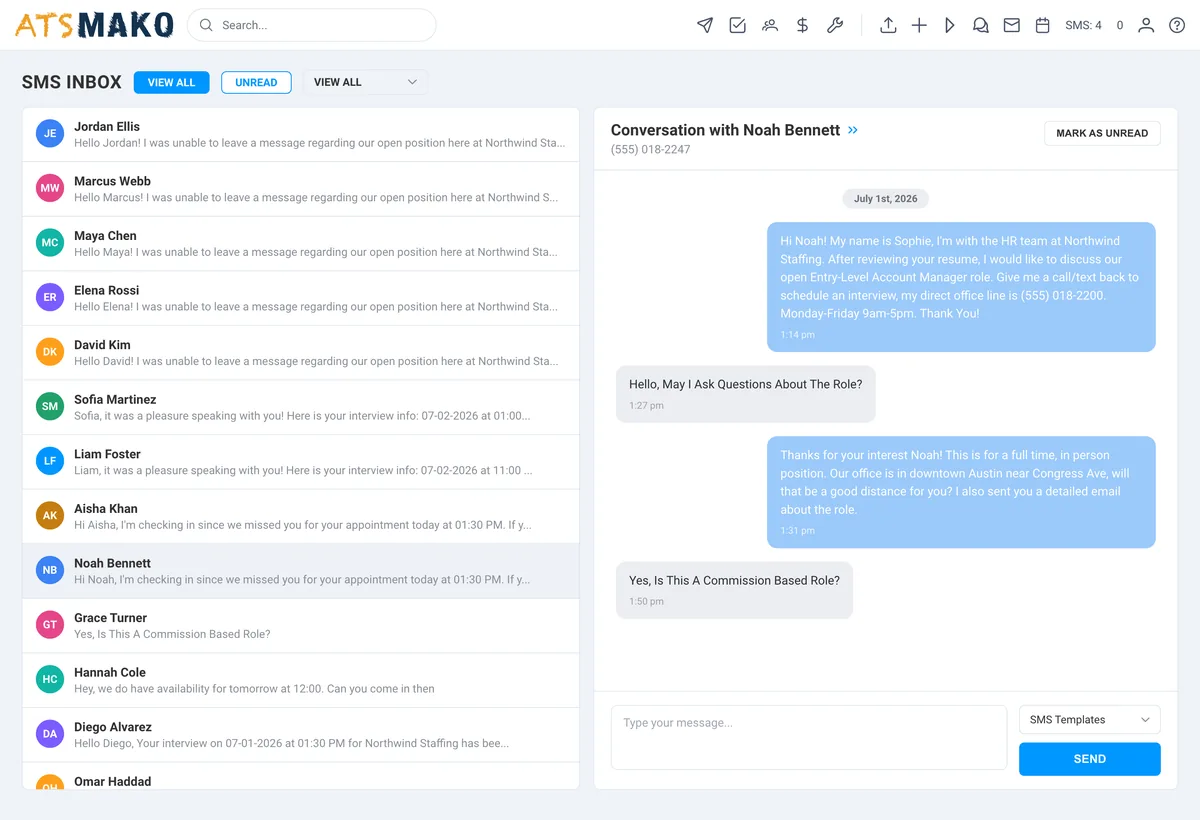
The conversation and the record are the same object
Should you move off Bullhorn?
If you are searching for alternatives, you already have a reason. The useful first step is naming it precisely, because the reason determines whether a platform change actually fixes it.
The most common reason staffing agencies change systems is not a missing feature. It is that recruiters have quietly moved candidate conversations into a separate texting app, and the ATS has stopped being the system of record.
If that describes your floor, the question is not "which tool has more features" - it is "which system do my recruiters actually work inside all day".
The test that settles it: open your current ATS and count how many of yesterday’s applicants received a real, human-quality response within 24 hours. If that number is low and your recruiters are texting from a separate app, the platform is the constraint.
Six questions to ask every vendor, including us
Ask these of Bullhorn, of ATS Mako, and of anyone else on your shortlist. Written answers, same questions, side by side - that is a real comparison, and it beats anything a vendor writes about a competitor.
Candidate communication
Ask: Is two-way SMS part of the core record, or a paid add-on / third-party integration? Where do replies land, and can a manager see the full thread on the candidate profile?
Why it matters: This is where most staffing agencies leak. If texting lives outside the ATS, your activity history is incomplete and your compliance record is worse.
ATS Mako’s answer: Two-way SMS and email are the core of the platform, not a bolt-on. Every message threads onto the candidate record and lands in one shared inbox.
Branding and white-label
Ask: Whose name is on the career portal, the application, the SMS sender, the offer letter and the notification emails? What does full white-label cost, and what stays branded by the vendor?
Why it matters: If you resell recruiting to clients, every vendor logo your candidate sees is a reminder that you are not the platform.
ATS Mako’s answer: Full white-label is standard: your logo, your colours, your domain across the portal, messaging and offers.
Screening at volume
Ask: What happens when 400 people apply to one req overnight? Is there AI ranking, AI phone screening, and bulk action on a filtered list - and are those included or metered?
Why it matters: High-volume hiring is won or lost in the first 24 hours. Manual triage does not scale past a few hundred applicants a week.
ATS Mako’s answer: AI candidate ranking, AI voice call screening and bulk actions across a filtered list are built in.
Pricing transparency
Ask: Get the all-in number in writing: per-seat licence, implementation fee, data migration, SMS and telephony usage, integration fees, minimum seats, and the renewal uplift.
Why it matters: Headline per-seat pricing rarely reflects the real annual cost. The gap is usually implementation and usage.
ATS Mako’s answer: Our current plans and terms are published on our pricing page rather than quoted case by case.
Implementation time
Ask: How long from signature to first placement made in the new system - not to "go live"? Who does the configuration, and is professional services required to change a pipeline stage?
Why it matters: A long implementation is a real cost: it is paid in recruiter productivity during the changeover.
ATS Mako’s answer: Configuration is self-serve - stages, fields, forms, templates and automations are admin-editable without a services engagement.
Exit terms
Ask: On the day you leave, what can you export, in what format, and who owns the phone numbers your candidates reply to?
Why it matters: Ask this before you sign, not when you are leaving. It tells you how a vendor thinks about the relationship.
ATS Mako’s answer: Your data is exportable and your candidate records stay yours.
We publish our own answers and no one else’s. That is deliberate: we are not in a position to describe another company’s product accurately enough to publish, and we would rather give you questions you can put to any vendor and hold them to in writing.
Three things that change a recruiter’s day
Not a feature list. The three design decisions behind ATS Mako that show up in how the work actually feels.
The conversation is the record
In most staffing stacks, the ATS holds the resume and a separate texting tool holds the actual relationship. Recruiters live in the second one. That split is why activity histories look thin, why a manager cannot reconstruct what was promised to a candidate, and why consent records are hard to produce. ATS Mako puts SMS and email in the core, so the thread and the record are the same object.
Branding you own end to end
For an agency, the platform is invisible infrastructure - the brand the candidate sees should be yours. Full white-label means the career portal, the application form, the text message sender, the offer letter and the notification emails all carry your identity. When you re-engage a placed contractor a year later, they recognise you, which is exactly why they reply.
Volume handled by the system, not by overtime
Four hundred applicants on a warehouse req is a staffing problem, not a data problem. AI ranking sorts against criteria you set, AI voice screening calls the shortlist, and bulk actions move hundreds of records in one pass. The measure is simple: how many of yesterday's applicants got a real response today.
When staying where you are is the right call
There are real situations where switching is the wrong move, and you deserve to hear them from us rather than discover them six weeks into an implementation.
Your back office runs through your ATS
Integrated pay/bill, timesheets and invoicing are deep, operationally critical capabilities. If your agency runs payroll and billing through its ATS, replacing that system is a finance project, not a recruiting one - and the bar for switching should be much higher.
You depend on a wide integration estate
If you rely on several niche integrations - VMS connections, background-check vendors, credentialing, analytics - inventory them honestly before you evaluate anything. A missing connector can outweigh every other advantage, whichever platform you are considering.
Enterprise VMS and MSP workflows
If most of your volume arrives through VMS portals and MSP programmes, submission workflow fit matters more than recruiter experience. Test that path specifically in any evaluation.
Years of process investment
Custom fields, reports, trained staff and documented process have real value in any system. Switching resets some of it. That cost is legitimate and belongs in the decision.
If two or more of these describe your agency, a platform change is probably not your highest priority this year. Fixing candidate response time inside what you already own may be.
What a switch actually involves
Four to six weeks is a realistic plan for a small to mid-size agency. The work is mostly data discipline, not software.
Inventory before you shop
List what actually lives in your current system: candidate records, resumes, notes and activity history, job history, custom fields, users and permissions, integrations, and consent records. You cannot evaluate a migration without knowing what has to survive it.
Test the export early
Ask for a real export from your current vendor while you are still evaluating. Formats and completeness vary, and threaded message history is the usual casualty. Better to learn that now than during cutover.
Run parallel through one hiring cycle
Keep the old system readable while the new one takes live reqs. In-flight candidates finish where they started; new reqs open in the new platform.
Validate in week one
Spot-check record counts, resume attachments, consent and opt-out records, and permissions. Confirm your SMS numbers and reply routing behave as expected before you retire anything.
Switching questions, answered.
Why does this page not include a feature and pricing comparison table?
Because we cannot verify them to the standard we would want before publishing. Vendor capabilities and pricing change constantly, tiers differ by contract, and most enterprise staffing platforms do not publish list pricing at all. A table full of confidently wrong cells about another company is worse than useless - it is the reason most "alternatives" pages should not be trusted. What we can give you honestly is the evaluation framework: the specific questions that separate platforms, why each one matters, and exactly what ATS Mako does. Ask both vendors the same questions and the comparison writes itself, with answers you can hold them to.
How long does switching from another ATS actually take?
For a small to mid-size staffing agency, plan four to six weeks end to end: one to two weeks to export and map data, one week to configure pipelines, fields and templates, one to two weeks running parallel on live reqs, and a validation week. The variable that moves this most is not the software - it is how much historical data you insist on bringing across and how clean it is. Our migration checklist walks the whole sequence.
Will we lose our candidate history?
Core records - candidates, resumes, jobs, placements, custom fields - typically migrate cleanly from any modern ATS via export. The part that most often arrives degraded, from any platform to any platform, is threaded email and SMS history, because message threads are stored very differently across systems. Ask your current vendor specifically what their export includes before you assume, and test it while you still have leverage.
Do we keep our phone numbers?
Ask this early, of every vendor including us. Candidates reply to the number they know, and number portability varies by platform and by carrier. It is a small detail that becomes a big problem at cutover if nobody raised it.
Is there a free trial so we can test with real data?
Yes - ATS Mako offers a free trial; current terms are on our pricing page. The most useful test is not a feature tour: take one real requisition, run it end to end in the trial, and see how many applicants get a genuine response in the first 24 hours.
We are an agency that resells recruiting to clients. Does white-label really matter?
It matters more than any single feature. If your client logs into a portal with another company's name on it, you have introduced your supplier to your customer. Full white-label - portal, application, SMS sender, offer letters, notification emails - keeps the relationship yours, which is the whole basis of the agency model.
Next steps in your evaluation
Note on vendor names. All product and company names are the trademarks of their respective owners and are used here only to identify the products a reader may be comparing. ATS Mako is not affiliated with, endorsed by, or sponsored by any other vendor referred to on this page. This page makes no representations or warranties about any other vendor’s features, pricing, performance or suitability - confirm those directly with the vendor concerned. Content is general information current as of the last-reviewed date, is not advice, and should not be relied on as the sole basis for a purchasing decision.
Run one real requisition through ATS Mako.
A 30-day free trial beats any comparison table. Take one live req, run it end to end, and count the responses.
30-day free trial · No setup fees · No long-term contracts